Collaboration For SDG Best Practice
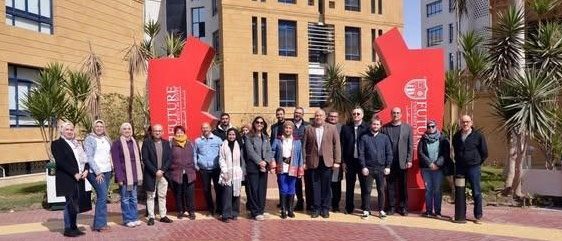
Al-Balqa Applied University (BAU) stands as a strong model of international and cross-sectoral collaboration, actively engaging in strategic partnerships, research initiatives, and capacity-building programmes that promote best practices aligned with the United Nations Sustainable Development Goals (SDGs). BAU actively uses international collaboration, comparative learning, and research partnerships to review approaches to sustainable development and exchange, adapt, and develop good practices for addressing the SDGs.
Through international projects and Memoranda of Understanding (MOUs) and Agreement with international universities and academic institutions, BAU engages in joint research, knowledge exchange, technology transfer, capacity building, and the comparative review of approaches across different national and regional contexts. These collaborations involve international organizations, non-governmental organizations (NGOs), civil society, public-private partnerships (PPPs), research and innovation networks, universities, and education and capacity-building institutions.
BAU’s international partnerships cover a wide range of SDG-related areas, including quality education, digital transformation, women’s employment, entrepreneurship, food safety, water management, climate resilience, sustainable agriculture, technical and vocational education, social inclusion, and innovation. Through these multifaceted partnerships, BAU exchanges expertise and experiences with international partners, reviews successful approaches from different contexts, tests innovative solutions, and strengthens institutional and professional capacities.
Through this approach, BAU not only participates in international collaboration but also translates international knowledge and comparative experience into practices that respond to local and regional needs. The university’s international partnerships therefore serve as mechanisms for continuous learning, knowledge transfer, innovation, and the development and adaptation of SDG-related best practices.
Sample of BAU’s Collaboration for SDG Best Practice
The following examples demonstrate how BAU engages in international collaboration to transfer expertise, strengthen institutional capacity, and explore practical approaches to addressing SDG-related challenges.
SPEEDUP: International Collaboration to Support Entrepreneurship and Sustainable Employment
Date: 2025-2028.
BAU participates in the SPEEDUP project, which promotes international cooperation across Cyprus, Egypt, Greece, Jordan, Lebanon, Spain, and Tunisia to support startups and innovative small and medium-sized enterprises (SMEs) in the Mediterranean region. The project brings together international partners to strengthen entrepreneurship, innovation, and employment opportunities, particularly for disadvantaged and unemployed individuals.
Through a network of local hubs, SPEEDUP provides mentoring, training, and business support to participants seeking to develop entrepreneurial ideas and establish sustainable and competitive businesses. These activities facilitate the exchange of knowledge and expertise among participating countries while supporting the development of practical skills and innovative approaches to entrepreneurship.
The project contributes to sustainable employment and inclusive economic development by helping disadvantaged and unemployed individuals access entrepreneurship support and develop the capabilities needed to establish and sustain businesses. Through international collaboration, BAU contributes to the exchange and adaptation of approaches that support entrepreneurship, innovation, employability, and sustainable economic growth in the Mediterranean region.
Relevant SDGs: SDG 4 – Quality Education, SDG 8 – Decent Work and Economic Growth, SDG 9 – Industry, Innovation and Infrastructure, SDG 10 – Reduced Inequalities, SDG 17 – Partnerships for the Goals. Project link
UPTAKERS: International Collaboration to Strengthen Digital Skills and Employability
Date: 2025-2028.
BAU participates in the UPTAKERS project, which promotes international collaboration between institutions in Europe and the Middle East to address the gap between graduates’ skills in the MENA region and the evolving requirements of the European labour market.
The project integrates Extended Reality (XR) technologies into teaching, communication, and project activities to enhance the digital skills, academic capabilities, and innovative potential of students, academics, and university communities. Through this approach, UPTAKERS facilitates the exchange of knowledge and innovative educational practices between participating institutions.
The project also promotes cross-border knowledge exchange and equal opportunities, while strengthening the alignment between higher education outcomes and changing labour-market needs. Through international collaboration, BAU contributes to developing future-oriented digital skills and innovative learning approaches that support graduate employability and sustainable economic growth.
Relevant SDGs: SDG 4 – Quality Education, SDG 8 – Decent Work and Economic Growth, SDG 9 – Industry, Innovation and Infrastructure, SDG 10 – Reduced Inequalities, SDG 17 – Partnerships for the Goals. Lunching Project
The Jordanian – Korean ICT Center: International Collaboration for Women’s Empowerment and Digital Inclusion
Date: the center was established in 2017.
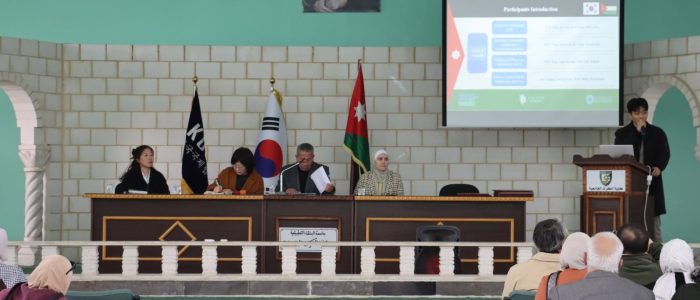
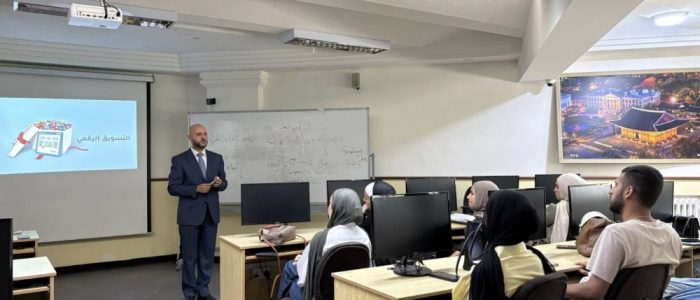
BAU demonstrates the transfer and adaptation of international best practices through the establishment of the Jordanian Korean Information and Communication Technology (ICT) Center, with support from the Republic of Korea’s National Information Society Agency (NIA). The Center represents an example of applying Korea’s experience in digital capacity building and information access within the Jordanian higher education and community context. Through this cooperation, BAU has developed a platform for transferring knowledge, expanding access to technology, and strengthening digital skills among students and community members.
The Center translates this international practice into local action through free training programmes, technology-equipped laboratories, and learning opportunities in areas such as programming, digital marketing, entrepreneurship, virtual reality, and emerging technologies. Attention is given to women’s empowerment and inclusive access to digital opportunities, helping participants develop practical skills that can support employment, business creation, and participation in the digital economy.
Relevant SDGs: SDG 4 -Quality Education, SDG 5 – Gender Equality, SDG 8 – Decent Work and Economic Growth, SDG 9 – Industry, Innovation and Infrastructure, SDG 10 – Reduced Inequalitie,
SDG 17 – Partnerships for the Goals. Center website
DISHOLEA: International Collaboration to Advance Digital Skills and Sustainable Production
Date: Not 2025.
BAU participates in the DISHOLEA project, co-funded by the European Union through the Erasmus+ programme. The project promotes international cooperation among nine institutions from Jordan, Palestine, Türkiye, Greece, and Spain to strengthen digital skills and vocational competencies in the footwear and leather-goods industries.
The project develops online training resources and innovative learning methods covering digital technologies, product design, manufacturing, quality control, and sustainable production. Through cooperation among international partners, DISHOLEA facilitates the exchange of expertise and vocational education practices, helping align training with the evolving needs of the footwear and leather industries.
Through this collaboration, BAU contributes to the transfer and adaptation of international approaches to digital vocational education, supporting workforce development, industrial innovation, and more sustainable production practices. The project provides an opportunity to share knowledge across countries and strengthen the connection between vocational training and industry need.
Relevant SDGs: SDG 4 – Quality Education, SDG 8 – Decent Work and Economic Growth, SDG 9 – Industry, Innovation and Infrastructure, SDG 12 – Responsible Consumption and Production, SDG 17 – Partnerships for the Goals. Projects link
DigitalLife4ALL: International Collaboration to Promote Digital Inclusion and Lifelong Learning
Date: 2025-2028.
The DigitalLife4ALL project promotes international collaboration among partners from Greece, Cyprus, Türkiye, Jordan, Tunisia, and Lebanon to advance digital inclusion and strengthen digital skills among older adults, persons with disabilities, and other vulnerable groups. Through cross-country cooperation, the project supports the exchange of knowledge and practices for making digital learning more accessible and inclusive.
The project uses Digital Hubs and mobile learning units to provide accessible and sustainable learning opportunities, helping participants develop digital competencies and improve their ability to engage with digital services and technologies. These approaches support the reduction of digital barriers and encourage participation in an increasingly digital society.
Through its international partnership, DigitalLife4ALL enables participating institutions to share experiences and adapt inclusive digital-learning approaches to different national and community contexts. The project contributes to the development and transfer of good practices in digital education, accessibility, and lifelong learning, supporting progress towards the Sustainable Development Goals.
Relevant SDGs: SDG 4 – Quality Education, SDG 9 – Industry, Innovation and Infrastructure, SDG 10 – Reduced Inequalities, SDG 17 – Partnerships for the Goals. Project Link
JICA–BAU: International Collaboration to Transfer Japanese Best Practices in Electric and Hybrid Vehicle Maintenance
Date: 29 June – 4 July 2024.
BAU, through its Faculty of Engineering Technology, collaborated with the Japan International Cooperation Agency (JICA) to deliver a specialised training course on electric and hybrid vehicle maintenance.The collaboration supports the transfer of Japanese expertise and international best practices in technical education and vocational training to the Jordanian context. Beyond strengthening participants’ technical and teaching skills, the programme introduced approaches designed to improve the quality of practical and theoretical training and align graduates’ competencies with local labour-market needs in electric and hybrid vehicle maintenance.
The course forms part of a broader cooperation programme between BAU and JICA covering two years. The agreement includes equipping laboratories at the Faculty of Engineering Technology and Ma’an University College with modern technical equipment to support practical and theoretical training. The programme aims to benefit more than 50 instructors through local training activities over the two-year period, while strengthening technical education, knowledge transfer, and workforce preparation in Jordan.
Relevant SDGs: SDG 4 – Quality Education, SDG 7 – Affordable and Clean Energy, SDG 8 – Decent Work and Economic Growth, SDG 9 – Industry, Innovation and Infrastructure, SDG 17 -Partnerships for the Goals. Event link
KOICA–BAU: International Collaboration to Strengthen Technical and Vocational Education and Graduate Employability
Date: 2024.
BAU collaborates with the Korea International Cooperation Agency (KOICA) to strengthen technical and vocational education and training (TVET) and improve employment opportunities for graduates. The project supports seven academic majors at Karak University College, Irbid University College, and BAU’s main campus, reflecting international cooperation to enhance the relevance and quality of technical education in Jordan.
The project strengthens practical training, industry-relevant skills, and graduate employability through career development services and local employment networks, transferring international expertise to support Jordan’s TVET sector.
Relevant SDGs: SDG 4 – Quality Education, SDG 8 – Decent Work and Economic Growth, SDG 9 – Industry, Innovation and Infrastructure, SDG 17- Partnerships for the Goals. KOICA Jordan Office
Technology Transfer Challenges and International Best Practices: Promoting Knowledge Exchange and Innovation
Date: 17 November 2024.
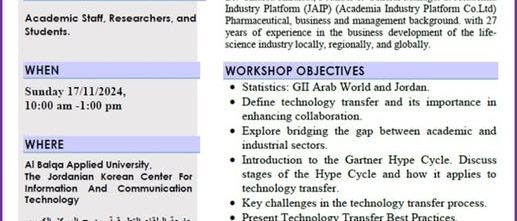
Al-Balqa Applied University organized a workshop titled “Technology Transfer Challenges & Best World Practices” targeted faculty members, researchers, and students, focusing on challenges in technology transfer and international best practices.
The workshop was delivered by Dr. Khaled Khreisat, founder and CEO of the Jordan Academy-to-Industry Platform (JAIP). It provided an opportunity to explore approaches to strengthening links between academia and industry and translating academic knowledge and research into practical applications.
Through this initiative, BAU promoted knowledge exchange and awareness of international practices that can support research commercialization, innovation, and university–industry collaboration.
Relevant SDGs: SDG 4 – Quality Education, SDG 9 – Industry, Innovation and Infrastructure, SDG 17 – Partnerships for the Goals. Workshop invitation
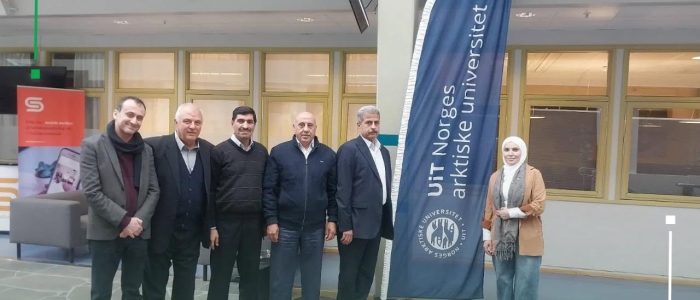
BAU–UiT: International Academic Collaboration in Energy, Water, and Environmental Sustainability
Date: 22–28 Sep 2025.
An academic visit to UiT. The Arctic University of Norway under the European Union-funded Erasmus+ programme and the cooperation agreements coordinated through BAU’s International Cooperation and Relations Unit.
The programme included visits to scientific laboratories and engineering workshops, enabling the delegation to explore research facilities and exchange academic and technical expertise.
The visit strengthened academic knowledge exchange between BAU and UiT and provided a platform to discuss future research collaboration in areas of shared interest. Both institutions emphasized the value of continued cooperation between engineering faculties, supporting the exchange of international research practices and collaborative approaches to sustainability challenges.
Relevant SDGs: SDG 4 – Quality Education, SDG 6 – Clean Water and Sanitation, SDG 7 – Affordable and Clean Energy, SDG 13 – Climate Action, SDG 17 – Partnerships for the Goals. Link