BAU’s Employment Policy on Discrimination
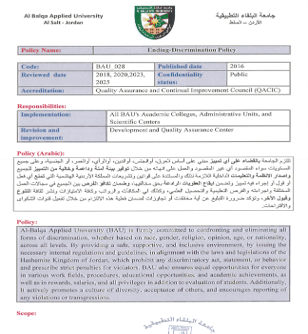
Al-Balqa Applied University (BAU) has its own institutional policies and frameworks to promote non-discrimination, equal opportunity, fairness, and inclusion across the University. In the academic environment and workplace, BAU is committed to fostering a fair, equitable, inclusive, and respectful environment in which all employees are treated with dignity and have equal opportunities.
This commitment reflected in the University’s Ending-Discrimination Policy, institutional regulations, recruitment procedures, and Diversity, Equity, and Inclusion (DEI) Strategy. These frameworks provide an institutional basis for promoting equal treatment and preventing discrimination on grounds including race, gender, religion, nationality, age, disability, as well as other forms of discriminatory treatment covered by policies and legislation.
Policy Scope
The Ending-Discrimination Policy applies to all BAU employees, students, contractors, partners, and relevant stakeholders across the University.
The policy applies to all academic colleges, administrative units, scientific centres, and other areas of University activity, covering employment, education, services, and institutional interactions.
Its scope includes, but is not limited to:
- Recruitment, appointment, and employment practices.
- Training and professional development.
- Performance evaluation and career development.
- Salaries, rewards, compensation, and benefits.
- Educational and academic opportunities.
- Teaching, learning, research, and academic participation.
- Workplace and learning-environment practices.
- Institutional services and interactions.
- Complaints, reporting, and appeals related to discrimination.
The policy addresses discrimination based on race, color, gender, religion, political belief, national origin, age, disability, and other prohibited forms of discriminatory treatment covered by applicable policies and legislation.
Policy Objectives
The Ending-Discrimination Policy aims to:
- Eliminate discrimination across BAU’s employment, academic, and educational activities.
- Ensure equal opportunities and fair treatment in recruitment, appointment, training, professional development, performance evaluation, compensation, rewards, benefits, and other employment processes.
- Provide a safe, supportive, and inclusive environment in which employees and students are treated with dignity and protected from discriminatory practices.
- Promote diversity, mutual respect, and acceptance as fundamental values within the University community.
- Ensure fairness and impartiality in access to educational, academic, employment, and professional development opportunities.
- Strengthen accountability and transparency through appropriate reporting, complaints, appeals, and follow-up mechanisms.
- Raise awareness and build institutional capacity through training, guidance, and communication on equality and non-discrimination.
- Monitor implementation and support continuous improvement of University policies, regulations, and practices related to equality and inclusion.
BAU’s Non-Discriminatory Admissions Policy, established in 2016 and periodically reviewed and developed, with the most recent review in 2025.
Legal and Institutional Framework for Non-Discrimination
BAU is committed to promoting equality, fairness, inclusion, and non-discrimination across all aspects of university life. This commitment is grounded in the principles established by the Constitution of the Hashemite Kingdom of Jordan, as well as applicable national laws and regulations governing higher education and public institutions.
Article 6 of the Jordanian Constitution establishes the principle of equality before the law and provides that Jordanians are equal in rights and duties, without discrimination on the grounds specified in the Constitution. It also affirms the State’s responsibility to provide work and education within its means and to ensure equal opportunities for Jordanians. BAU translates these national principles into institutional practice through its policies, regulations, procedures, and governance mechanisms.
In support of these principles, BAU has established institutional regulations and procedures for the prevention of discrimination and the submission and handling of complaints. These mechanisms provide members of the University community with channels to raise concerns and lodge relevant complaints, safeguard their rights in the workplace, and contribute to maintaining a work environment free from discrimination.
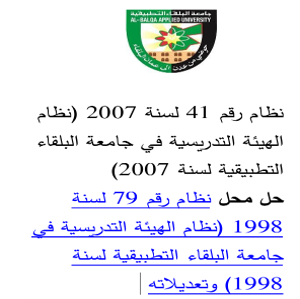
The University’s commitment to non-discrimination supported by its academic and administrative staffing regulations, employment and recruitment procedures, student-related policies, and institutional governance frameworks. Together, these frameworks promote fair and equitable treatment in employment, recruitment, admission, academic opportunities, professional development, promotion, and access to university services, while reinforcing BAU’s commitment to equal opportunity, dignity, fairness, and respect for all members of its university community.
Through this integrated legal and institutional framework, BAU seeks to ensure that decisions and practices are based on merit, qualifications, performance, institutional needs, and applicable regulations, while preventing discrimination, harassment, favoritism, or unequal treatment. The University also provides institutional mechanisms for addressing concerns and ensuring compliance with applicable policies and professional standards.

Non-Discrimination in the Workplace at BAU
- Diversity, Equity, and Inclusion
BAU promotes a diverse and inclusive university community through its Diversity, Equity, and Inclusion Strategy. The strategy provides an institutional framework for strengthening the university’s commitment to equal opportunity, fostering a culture of respect and inclusion, and supporting individuals from underrepresented groups.
The strategy emphasizes three key objectives:
- Strengthening the university’s commitment to an environment free from discrimination at all levels.
- Establish and sustain a diverse, equitable, and inclusive institutional culture.
- Providing support and resources for students and staff from underrepresented groups.
These objectives reinforce the university’s broader approach to preventing discrimination and fostering an environment in which employees are treated fairly and respectfully.
- Employee Information and Human Resources Practices
BAU’s employee portal and Human Resources information systems focus on information required for employment and personnel administration. Religion is not used as an employment-related criterion, and the employee portal does not require employees to provide information about their religion.
BAU’s employment practices structured around information and criteria relevant to the employment relationship, while employment-related decisions are guided by qualifications, professional competence, experience, performance, and job requirements.
- Fair and Non-Discriminatory Recruitment
BAU promotes transparency and equal opportunity in recruitment by officially announcing vacancies and clearly communicating the relevant qualifications, experience, competencies, and job requirements for each position.
Recruitment announcements are based on the requirements of the position and do not introduce references to religion, ethnicity, or other discriminatory eligibility criteria unrelated to professional suitability.
The University’s academic staffing regulations provide a formal framework for academic appointments, with professional and academic qualifications forming the basis of appointment requirements.
Example of announced vacancy: Job Vacancy Announcement at Al-Balqa Applied University
- Equal Opportunities for Career Development, Scholarships and Academic Missions
Example of Equal Opportunities for Scholarships vacancy
BAU’s commitment to non-discrimination extends beyond recruitment to opportunities for professional development, career advancement, scholarships, academic missions, postgraduate study, training, and other forms of capacity development.
Access to these opportunities is guided by established academic, professional, and institutional criteria, such as qualifications, academic or professional performance, specialization, experience, programme requirements, and institutional needs.
BAU seeks to ensure that opportunities for career and academic development are available on an equitable basis and that selection is not influenced by religion, ethnicity, gender, or other characteristics unrelated to the requirements of the opportunity.
This approach supports equal access to opportunities that enable employees to enhance their qualifications, develop their professional competencies, pursue further education, and advance their careers within the University.
- Academic and International Exchange Opportunities
BAU also applies principles of fairness and equal opportunity to academic exchange, international mobility, staff training, professional development, and cooperation programmes.
Opportunities for participation in exchange and mobility programmes communicated through institutional procedures and official calls or nominations, with selection based on the requirements of the specific programme and relevant academic or professional criteria.
Accordingly, participation in academic and international exchange opportunities guided by eligibility requirements, academic or professional suitability, qualifications, programme objectives, and established institutional procedures, rather than discriminatory considerations unrelated to the opportunity.
Through these practices, BAU seeks to ensure that employees have equitable opportunities not only to join the University, but also to develop professionally, pursue further qualifications, participate in international mobility and exchange, and access opportunities for academic and career advancement.
Example of announced vacancy: Exchange and Mobility Opportunity
- Code of Conduct and Ethics
BAU has adopted a Code of Conduct and Ethics that establishes standards of professional behavior and promotes integrity, respect, fairness, equality, dignity, and professional responsibility within the University community.
The Code provides guidance on appropriate professional conduct and reinforces the expectation that employees and other members of the University community interact with one another in a respectful and professional manner.
Together with the Ending Discrimination Policy and DEI Strategy, the Code contributes to an institutional environment that promotes respect and helps prevent discriminatory or inappropriate conduct in the workplace.
- Reporting and Accountability
BAU promotes transparency and accountability by providing established channels for reporting discrimination, raising concerns, submitting inquiries, and providing feedback. Through its institutional Inquiries, Complaints and Suggestions System, employees, students, stakeholders, and members of the public can communicate concerns and report potential violations of the University’s policies and regulations.
Submitted complaints and concerns are addressed through the applicable institutional procedures, supporting appropriate follow-up and continuous improvement. These mechanisms help reinforce the implementation of BAU’s non-discrimination principles and promote a fair, respectful, and inclusive working and learning environment.