Employment Practice Living Wage
Al-Balqa Applied University (BAU) is committed to providing fair, equitable and adequate remuneration to its employees in accordance with its approved salary system and applicable national legislation. The University’s remuneration framework establishes salary scales and employment-related benefits for academic and administrative employees, supporting fair compensation, financial security and employee well-being.
Minimum Salary and National Wage Comparison
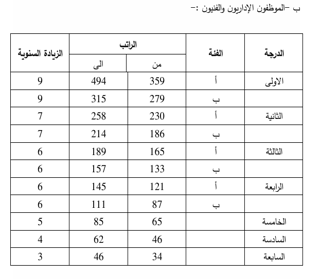
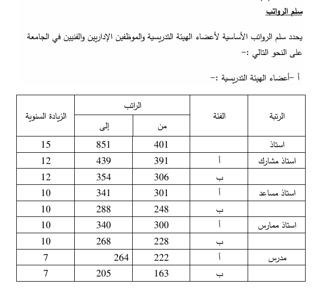
In 2025, the lowest monthly salary paid by BAU to employees in the lowest salary grade, including seventh-grade administrative employees, was JOD 410 per month. By comparison, administrative employees in the first grade may receive more than JOD 1,000 per month, depending on their years of service, applicable allowances and other salary-related entitlements. Academic staff holding the rank of Professor may receive more than JOD 2,500 per month, depending on academic rank, years of service and applicable allowances and benefits.
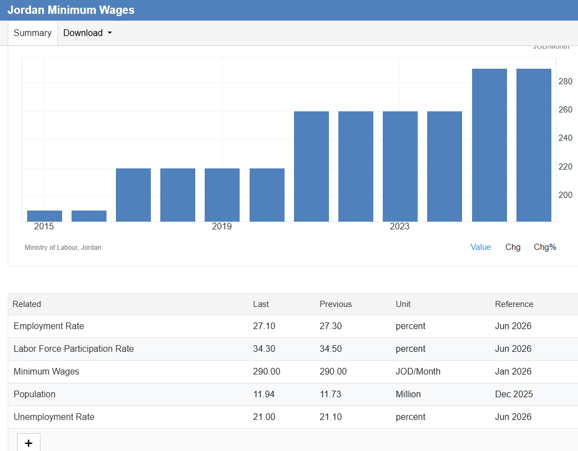
BAU’s lowest monthly salary of JOD 410 was JOD 120, or approximately 41.4%, higher than Jordan’s statutory minimum wage of JOD 290 per month, which took effect on 1 January 2025 for workers covered by the Jordanian Labour Law. The statutory minimum wage had previously been JOD 260 per month.
Salary and Allowances System of Al-Balqa Applied University
BAU regulates the salaries and allowances of its academic, administrative, and technical employees through its Salary and Allowances System and its amendments. The system establishes salary scales according to academic rank for faculty members and salary grade and category for administrative and technical staff. It also provides for annual increments and various allowances, subject to the applicable regulations and eligibility requirements.
For academic staff, the salary structure distinguishes between academic ranks, including Professor, Associate Professor, Assistant Professor, Practitioner Professor, Lecturer, and Assistant Lecturer. For administrative and technical employees, the salary scale comprises seven grades, with salary levels varying according to grade and category.
In addition to basic salaries, the system provides for applicable allowances, which may include university allowances, transportation allowances, specialization allowances for eligible academic staff, and administrative responsibility allowances for employees assigned to designated leadership positions.
BAU’s salary structure provides employees with a level of financial compensation that is substantially above Jordan’s statutory minimum wage and, based on the reported salary figures, well above the national poverty threshold. These salary levels contribute to employees’ financial security and well-being, although actual earnings vary according to individual employment circumstances. Overall, the system provides an institutional framework for determining employee compensation based on job classification, academic rank, years of service, and applicable entitlements, while supporting financial stability and recognizing differences in professional responsibilities and qualification
Additional Financial Benefits
BAU’s employee remuneration framework extends beyond the regular monthly salary. Eligible employees may receive end-of-service benefits of up to three times the employee’s salary for each eligible year of service, subject to the University’s applicable regulations, eligibility requirements and calculation provisions. This entitlement provides additional financial recognition linked to employees’ service and length of employment.
Employees required to work outside their normal working hours are also eligible for additional compensation calculated according to the number of approved hours worked, in accordance with the University’s applicable regulations and procedures. Overtime payments are provided in addition to the regular monthly salary.
End-of-Service Benefits System
Al-Balqa Applied University regulates staff rewards, end-of-service benefits, and compensation through the Staff Rewards and Compensation System No. 17 of 2000 and its amendments. The system applies to full-time academic and administrative employees and establishes financial entitlements associated with the completion of service, work-related injuries, and death resulting from work.
The system provides end-of-service rewards based on employees’ eligible service periods and the applicable salary basis. It also sets out provisions governing the payment of these rewards, including the possibility of receiving a portion during service, subject to specified eligibility requirements and university instructions. In addition, it establishes compensation arrangements for qualifying work-related injuries and compensation for an employee’s family in the event of a work-related death.
Through this framework, BAU provides a formal mechanism for protecting eligible employees’ financial rights and supporting their welfare and that of their families. The applicable benefits depend on the employee’s appointment date, length of service, circumstances, and the relevant provisions and amendments.